Formula One’s ‘Drive to Survive’, tennis show ‘Break Point’ and the NFL-based series ‘Quarterback’ and ‘Receiver’ – when a sport becomes popular, a show is likely to follow.
With padel’s meteoric rise in popularity, a show was inevitable; the only question was which production company would be first on the ball.
However, it’s not the big red N who looks to have a documentary series about every major sport.
This time, a much smaller UK production company will be the one to bring the world of padel to the mainstream.
Paul Woodman, the presenter of Amazon Prime Video’s ‘On the Road’, is the mind behind the newly-announced padel series.
Set to be released in 2026 and with the working title ‘Padel Planet’, the platform on which to stream the show and the full line-up will be announced in the coming months.
Here, Sports News Blitz’s padel writer Vanely Barumire takes a look at who we would love to see on this show…
Arturo Ceollo
Ceollo’s rise to fame and the top of the padel world is a storyline that the show cannot miss.
Becoming the youngest player in history to reach the world number one ranking, Cello would make a great addition, having dominated the sport since he was only 21 years old.
The Spanish player could also attract a tennis fanbase, having played tennis before, ultimately choosing the lesser-known racket sport for “its potential”.
Also, it wouldn’t hurt the show to have someone who has a close relationship with one of the best tennis players in the world – Carlos Alcaraz.
Ranked as the world number one alongside his partner Arturo Ceollo, Agustin Tapia would be a much-needed addition to the line-up.
Nicknamed ‘The Mozart of Catamarca’, fans would certainly be excited to see behind-the-scenes footage of the Argentine – his training, matches and relationship with Arturo Ceollo.
With over 800,000 Instagram followers, Tapia’s social media reach will be vital in making the show digitally successful and plus, everyone would love to know his secret to dominating the game.
Federico Chingotto
Known as the prankster on tour, Chingotto would be a refreshing addition to the newly-announced padel series.
With the charm and humour of Daniel Ricciardo and the court coverage of Novak Djokovic, Chingotto could easily become the heart of the show.
And a much-needed relief from the high-paced world of padel.
Alejandro Galan
The other half of Chingotto is Alejandro Galan – the most well-known padel player.
With sponsorships from Red Bull and Adidas, the Spanish player has earned the recognition of being one of the best players of all time.
If the show is to be taken seriously, it cannot miss the opportunity to have Alejandro Galan involved.
As padel becomes increasingly popular across the globe, people from all walks of life are joining in on the fun and games – old and young, professional and amateur alike, as well as differently-abled individuals.
But the growth of the sport presents more opportunity for injury. A common example is a player who develops the tennis elbow (or lateral epicondylitis), which can occur from overusing the muscles and tendons in the elbow, particularly among amateur players.
With the growing number of padel players globally, experts warn of increasingly common injuries – like tennis elbow – associated with this racket sport.
Sports News Blitz’s padel writer Shameeka Voyiya delves further into what players need to know.
Common injuries
Common injuries usually arise from the dynamic movements involved in gameplay, including sudden sprints, quick changes of direction and repetitive movements.
“Many of the common padel injuries affect the lower limbs, with ankle sprains, overused knees, calf and thigh strains, and Achilles tendon [are] problems fairly common – particularly in players over 30 and in those who are new to the game,” Dr. Ashley Naidoo, orthopaedic surgeon, told IOL.
“Padel players should also be aware of the risk of upper limb injuries, as pain or strains affecting the elbow, shoulder, and wrist are also prevalent, especially among players using heavy rackets and less experienced players who are still working on improving their technique.”
Indeed, a shift from not playing a racket sport at all to potentially playing multiple times a week will likely cause strain on your body.
The rate of injury for padel players is three per 1,000 hours of training and eight per 1,000 matches. The overall prevalence range is 40 per cent to 95 per cent, according to current physiotherapy literature.
Other causes of injury include insufficient warming up, skipping warm ups entirely or using the wrong equipment, as padel rackets come in varying levels of weight and softness.
Naidoo stressed the importance of appropriate footwear in the prevention of injury.
“Padel is played on synthetic turf, often with sand infill, and requires lateral grip and ankle support. Running shoes and general trainers are unsuitable, increasing the risk of slipping or ankle rolls,” he said.
“Footwear designed specifically for padel or clay tennis surfaces offers the best protection.”
Other experts recommend building overall muscle strength using a regular exercise routine.
It’s also advised that players choose a racket that suits their playing style and strength, as an inappropriate racket can lead to strain.
“By combining smart training, proper preparation, suitable footwear, and evidence-based rehabilitation, players of all ages can enjoy padel while minimising injury risk.
“Whether you’re playing socially or competitively, whether you’re 25 or 65, playing smart today can help you stay on court and pain free for years to come,” Naidoo said.
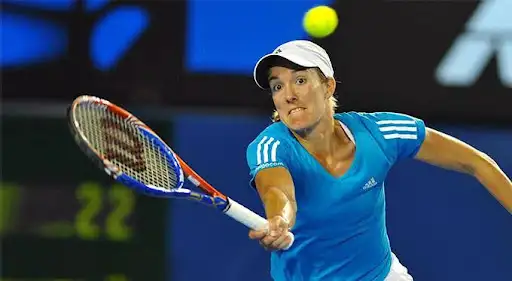
Justine Henin is a legendary figure in tennis, one of the game’s true icons.
A former Belgian world No. 1 ranked for 117 weeks, she amassed seven Grand Slam titles (four French Opens, two US Opens, one Australian Open), an Olympic gold medal, and became a symbol of mental fortitude and technical elegance.
Today, she is a sought-after Tennis speaker, sharing her remarkable journey and lessons from the world’s grandest courts with audiences everywhere.
Whether mentoring academy students, guiding professionals, or inspiring organisations, Justine brings the same deliberation and passion that defined her career.
In this exclusive interview with The Champions Speakers Agency, Justine opens up about her unwavering belief in dreams, the power of mental resilience, and what it takes to support the champions of tomorrow.
Q: As Founder and President of the Justine Henin Tennis Academy, how important is it to encourage and support the next generation of tennis players?
Justine Henin: “It is very important to me, and we can see in the time that we live right now with this sanitary crisis that sport can have a big influence in a lot of people’s lives. It’s not everything, and not everyone has to do sports to be happy or to be in balance, you know.
“But our philosophy is not only the high level, the top level, you know, because we know champions – you don’t have so many champions.
“You have different kinds of goals and different kinds of stages. You can become professional, sometimes you want to become the best, and not everyone can become the most and not everyone can become professional, of course, in sport.
Stay realistic
“Our philosophy is to guide the student and the player into his or her project, always to stay realistic but to make sure that we can contribute to the development of the player and the human being.
“It’s very important for us because we believe that sport can give a lot of things in life and bring a lot of balance, and the values that most of the time are in sport. I really defend that a lot because I think you learn – it’s an amazing school of life.
“I stopped school when I was 16. I wouldn’t say that to my kids, or to the students of theacademy of course.
“It’s very good to combine because you need that security, and of course today a lot of things have to change. You can imagine your school differently than in the past, and certainly in this time right now.
Amazing experience
“But I stopped school when I was 16, and I was a good student. But yeah, travelling for tennis, it’s been an amazing experience, and how many things I learned about myself: to be responsible, to be able to count on myself, and not finding excuses.
“In an individual sport it’s very strong – you have to face yourself.
“So, we try to work on that and many other things of course, but to become responsible adults – that’s the goal for everyone. Yes, it’s important to send messages, even if it’s small and we can’t make the difference, but we try to bring something more, to build the experience of the athletes.”
Q: Tennis is one of the most high-pressure sports in the world. What is the secret to staying calm and performing under such immense pressure?
Justine Henin: “When you have the chance to find a guide, as a coach or different kinds of people around you to help you in this journey, you’re very lucky. It’s been my case. I’ve always had the feeling I was in a good environment.
“There is probably a little bit of chance, but also, it’s a question of trusting the process. For me it was really important: if I go into this, I give my confidence and I trust what I put in place.
Trust the process
“Sometimes you have to question yourself and change or adjust things, but to trust the process is really important.
“To stay calm… I am not really calm inside. Now I’m calmer than I was in the past. My natural state is really to be anxious, but I could control that a lot during my career.
“Of course, the stress is there, the pressure is there.
“If you want to have no pressure in your life, you don’t choose sport at high level because the pressure is going to be all the time.
“You play a match and, as a competitor, you want to win, of course – and you don’t know what’s going to happen. You have to accept it.
Visualisations
“I was using a lot of visualisations. It was really a strong tool that I was using before matches, but not only before matches – even sometimes during long training periods.
“I used it to project myself on positive things. When I was nervous, I thought it’s normal, I’m nervous, I feel it, so I need to think it’s normal, because it is. That’s the first thing: to accept it. Then I deal with it.
“I really tried to visualise before every match only positive thing. I was scared, but while I was trying to visualise, you know – a winner in forehand or a serve-and-volley – I was seeing myself being really aggressive in my game.
“I imagined I was winning the match, even saying thank you to the umpire, to the crowd, to everyone, as the winner. I was really putting myself in something positive in my mind.
“It’s not that the stress wasn’t there anymore – it’s just that I had less energy to give to my fears. I was focused on something positive, and this is how I tried to control the fact that I was nervous.
“It was really something powerful for me during my whole career.”
This exclusive interview with Justine Henin was conducted by Chris Tompkins of The Motivational Speakers Agency.